

Table of Contents
How to Write a Check: A Step-by-Step Guide for the USA
Writing a check may feel old-fashioned in a world of debit cards, payment apps, and online banking, but checks are still used in the United States for rent, contractors, school payments, gifts, government-related payments, and other transactions.
If you have never written a check before—or you simply haven’t written one in years—the process can seem confusing. The good news is that it only takes a few minutes once you understand what each section means.
In this guide, I’ll show you how to write a check correctly in the USA, explain each part of a personal check, provide practical examples, and share some important security precautions that can help reduce the risk of check fraud.
Quick Answer: How Do I Write a Check?
To write a personal check in the United States, I follow these six basic steps:
- Write the date.
- Write the name of the person or business I’m paying.
- Enter the payment amount in numbers.
- Write the payment amount in words.
- Add a memo if needed.
- Sign the check.
Before handing over or mailing the check, I always verify that the payee and the two versions of the payment amount are correct.
Let’s look at every step in detail.
How to Write a Check Step by Step
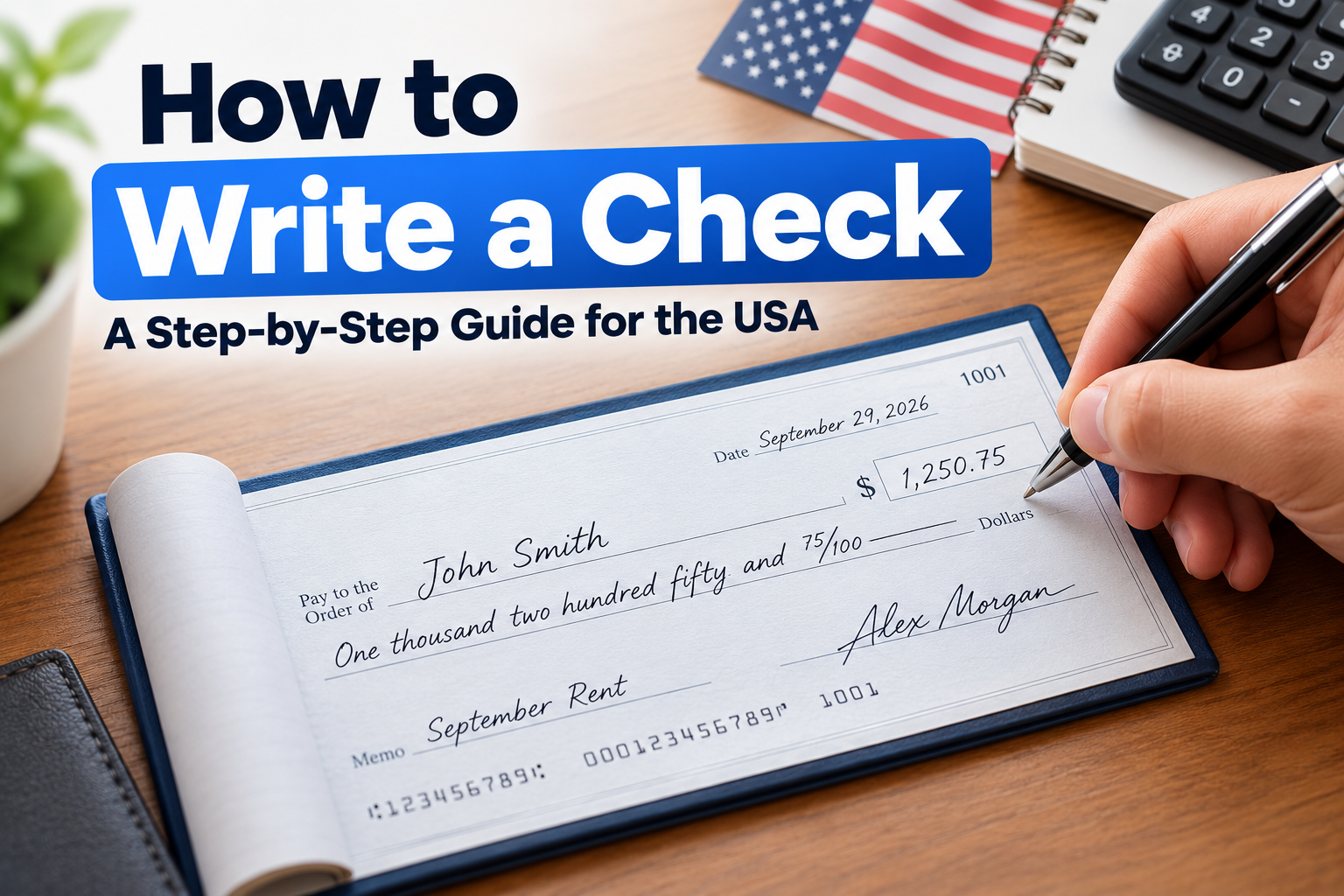
For this example, suppose I’m writing a check for $1,250.75 to John Smith for September rent.
Step 1: Write the Date
In the upper-right corner of the check, I write the current date.
For example:
September 29, 2026
I can also use a numerical format such as:
09/29/2026
Using the current date is usually the simplest approach.
What About Post-Dated Checks?
A post-dated check has a future date instead of today’s date.
For example, if today is September 29 but I date my check October 5, I have post-dated the check.
However, I don’t assume that simply putting a future date on a check guarantees that the bank will wait until that date to process it. The Consumer Financial Protection Bureau (CFPB) explains that banks and credit unions generally may process a post-dated check before the date written on it. State law and proper advance notice to the financial institution can affect how a post-dated check is handled.
For that reason, if timing is important, I contact my bank or credit union and ask about its specific post-dated-check policy rather than relying on the date alone.
Step 2: Write the Payee’s Name
Next, I find the line that says:
Pay to the Order of
On this line, I write the full name of the person, company, or organization receiving the money.
Example:
John Smith
If I’m paying a business, I use the business name the company tells me to use.
For example:
ABC Property Management LLC
I avoid leaving the payee line blank. A blank payee field creates unnecessary risk because someone who obtains the check could potentially fill in a name.
I also avoid making a check payable to Cash unless I have a specific reason to do so. A check payable to Cash can be risky if it is lost or stolen.
Step 3: Write the Amount in Numbers
On the right side of the check, I find the small box next to the dollar sign.
Here I write the payment amount numerically.
For our example:
$1,250.75
I write the amount close to the dollar sign or left side of the box rather than leaving unnecessary blank space.
Even when there are no cents, I still clearly show the cents.
For example:
$500.00
instead of simply:
500
This makes the intended amount clearer.
Step 4: Write the Amount in Words
Below the payee line is a longer line where I write the amount using words.
For a check worth $1,250.75, I would write:
One thousand two hundred fifty and 75/100 dollars
The cents are normally written as a fraction of 100.
Here are a few more examples:
| Numeric amount | Written amount |
|---|---|
| $25.00 | Twenty-five and 00/100 dollars |
| $100.50 | One hundred and 50/100 dollars |
| $1,000.00 | One thousand and 00/100 dollars |
| $2,475.25 | Two thousand four hundred seventy-five and 25/100 dollars |
After writing the amount, I draw a line through any unused space before the word “Dollars” if the check design leaves room.
For example:
One hundred fifty and 00/100 ————— Dollars
This makes it harder for someone to add extra words to the amount.
What If the Numeric and Written Amounts Don’t Match?
I don’t intentionally send a check when the amounts are inconsistent.
If I notice the mistake before giving the check to anyone, the safest and cleanest approach is usually to void that check and write a new one.
Step 5: Fill In the Memo Line
The memo line is normally located in the lower-left portion of a personal check.
The memo is generally used to record the purpose of the payment.
For example:
September Rent
Other examples include:
Invoice #1045
Tuition
Birthday Gift
Plumbing Repair
When I’m paying a company, the company may ask me to include an invoice number, customer number, or another reference in the memo field.
The memo is useful for recordkeeping, but filling it in does not replace correctly completing the payee, amount, and signature fields.
Step 6: Sign the Check
Finally, I sign the check on the signature line in the lower-right corner.
My signature authorizes the check.
I don’t sign blank checks in advance. I complete the payee and payment amount first and sign the check only when it is ready to be issued.
An unsigned check will generally not be accepted or may be returned by a bank or credit union.
Example of a Completed Check
Using our example, my completed check would contain:
| Field | Example |
|---|---|
| Date | September 29, 2026 |
| Pay to the Order of | John Smith |
| Amount box | $1,250.75 |
| Written amount | One thousand two hundred fifty and 75/100 dollars |
| Memo | September Rent |
| Signature | My signature |
That’s all I need to complete on most standard U.S. personal checks.
Understanding the Parts of a U.S. Check
Besides the fields I fill out myself, a personal check contains several pieces of information that are normally preprinted.
Understanding these numbers can be useful, especially when setting up direct deposit or other banking services.
1. Routing Number
The routing number identifies the financial institution associated with the account.
A U.S. routing number is a nine-digit number.
It usually appears along the bottom of the check as part of the machine-readable information.
I don’t write or change this number myself; it is printed on the check.
2. Account Number
The account number identifies my specific checking account at the financial institution.
It also generally appears along the bottom of the check.
Because my routing and account information appears on a check, I treat both blank and completed checks as sensitive financial documents.
3. Check Number
Each check normally has a check number that helps identify and track the transaction.
The check number commonly appears in the upper-right corner and again in the information printed along the bottom.
If I’m recording the payment in a check register, I include this number.
4. My Personal Information
Personal checks may contain information such as my:
Name
Address
City and state
A phone number generally isn’t necessary simply to write a check.
I also avoid unnecessarily adding sensitive information such as my Social Security number, driver’s license number, or other private information to a check.
5. Bank Information
A personal check normally displays the name of the bank or credit union associated with the checking account.
The design and exact location of this information vary among financial institutions.
What Is the MICR Line on a Check?
The numbers and special symbols printed across the bottom of a check are commonly called the MICR line.
MICR stands for Magnetic Ink Character Recognition.
Depending on the check design, this area contains information used to process the check, including the routing number, account number, and check number.
One important correction I make when explaining U.S. checks is that this isn’t an IBAN.
The United States does not use IBANs for ordinary domestic personal checking in the way many other countries do. For a U.S.-focused guide, routing and account numbers are the relevant concepts.
How to Write a Check With Cents
Suppose I need to write a check for:
$84.37
In the number box, I write:
84.37
On the written-amount line, I write:
Eighty-four and 37/100 dollars
The number after the slash represents cents because one dollar contains 100 cents.
How to Write a Check With No Cents
Suppose my payment is exactly:
$600
In the amount box, I write:
600.00
On the written line, I can write:
Six hundred and 00/100 dollars
Writing 00/100 makes it clear that the check includes no cents.
How to Write a Check for $1,000
For a $1,000 check:
Numeric amount: $1,000.00
Written amount: One thousand and 00/100 dollars
The same pattern works for larger amounts.
For example, $5,275.40 becomes:
Five thousand two hundred seventy-five and 40/100 dollars
What Should I Do If I Make a Mistake on a Check?
If I make a significant mistake while writing a check, I prefer not to scribble over it, use correction fluid, or make complicated alterations.
Instead, I write:
VOID
clearly across the check and start with a new one.
I also record the voided check number so I know why that check is missing from the numerical sequence.
If I’ve already delivered a check containing an error, I contact the recipient and my bank if necessary rather than trying to modify a check that is no longer in my possession.
How to Void a Check
Sometimes I may be asked for a voided check when setting up direct deposit or certain electronic payments.
To void a check, I write:
VOID
in large letters across the front.
I make sure I don’t cover the routing and account numbers if the organization legitimately needs those numbers to establish the electronic transaction.
I never sign a check that I’m providing solely as a voided check.
Because a voided check still contains sensitive banking information, I only provide it to an organization I trust.
Keep a Record of Every Check
After writing a check, I record the transaction rather than relying only on my current online banking balance.
I record information such as:
Check number
Date
Payee
Amount
Purpose
I can use the check register that comes with a checkbook, a spreadsheet, budgeting software, or another financial recordkeeping method.
This helps me remember checks that have been written but haven’t yet cleared my account.
For example, my bank balance might show $2,000, but if I recently wrote a $750 check that hasn’t been deposited yet, I don’t treat the full $2,000 as available for spending.
Make Sure You Have Enough Money in Your Account
Before I write a check, I make sure my checking account can cover it.
A check can take time to be deposited and processed, so I continue treating that money as committed even if it still appears in my available account balance immediately after I write the check.
If a check is presented when there isn’t enough money available, the payment may be returned or handled according to my financial institution’s account and overdraft policies, potentially resulting in fees or other consequences.
How to Write a Check Safely
Check fraud remains an important reason to handle checks carefully.
The CFPB warns consumers about check washing, a form of check fraud in which criminals obtain legitimate checks and alter information such as the payee or payment amount.
When I need to use a paper check, I follow several precautions:
- I use permanent black ink or black gel ink rather than erasable ink.
- I fill out the payee and amount fields completely.
- I don’t leave large blank spaces that could make alteration easier.
- I never sign blank checks.
- I store unused checks securely.
- I regularly review my checking account for unfamiliar transactions.
- I securely destroy old or unused checks that I no longer need.
- If I mail an important check, I take additional precautions rather than leaving it unattended in an unsecured mailbox.
The CFPB specifically advises consumers who mail checks to take them directly to a post office rather than leaving them in a home mailbox. It also recommends checking incoming mail frequently and avoiding leaving mail in a mailbox overnight.
Be Careful With Fake Check Scams
Another risk isn’t someone altering a check I’ve written—it’s someone sending me a fraudulent check.
A common scam works like this:
Someone sends me a check, often for more money than expected. They ask me to deposit it and then send some of the money back through another payment method.
My bank may initially make some funds available, which can make the check appear legitimate.
Later, however, the check may be discovered to be counterfeit. If I’ve already sent money to the scammer, I could be responsible for the loss.
The FDIC warns consumers to be particularly cautious when an unknown person sends a check and asks them to return part of the money.
If I receive a suspicious cashier’s check or other bank check, I don’t rely solely on the phone number printed on the check. I independently find the issuing bank’s official contact information and ask how the check can be verified.
Mailing a Check Safely
If I need to mail a check in the United States, I take extra care because a stolen check can expose both the payment and banking information.
I:
Complete every field before mailing it.
Use permanent black or gel ink.
Avoid leaving outgoing checks sitting in my residential mailbox.
Take sensitive check mail directly to a post office when practical.
Monitor my account afterward to confirm the correct payment clears.
If the payment is particularly important, I may also consider a mailing option that provides tracking, depending on the situation.
What If My Check Is Lost or Stolen?
If one of my checks or my entire checkbook is lost or stolen, I contact my bank or credit union as soon as possible.
I don’t wait for an unauthorized transaction to appear.
The financial institution can explain what actions are appropriate for my account, which might include monitoring the account, placing a stop-payment order, replacing checks, or taking additional security measures.
How Do I Stop Payment on a Check?
If I need to prevent a check I’ve written from being paid, I contact my bank or credit union immediately.
The CFPB notes that the procedure and duration of a stop-payment request can vary by financial institution, and a bank or credit union may charge a fee.
I should be prepared to provide information that helps identify the check, such as its:
Check number
Payee
Amount
Date
I also understand that timing matters. If the check has already been fully processed, requesting a stop payment afterward won’t undo the completed payment.
Do Checks Expire?
Personal checks don’t necessarily “expire” on a single universal date in the same way a coupon or driver’s license does.
However, a check presented 180 days (six months) or more after its issue date is generally considered a stale-dated check under U.S. banking terminology.
Banks aren’t necessarily required to honor stale-dated checks, although circumstances and bank policies can vary.
If I find an old check that I haven’t deposited, I contact the person or organization that issued it and ask whether they can replace it rather than assuming the bank will accept it.
Personal Check vs. Cashier’s Check
A personal check is drawn against money in my checking account.
A cashier’s check works differently. It is issued by a financial institution and is commonly used when a recipient wants a more formal form of payment, particularly for larger transactions.
However, a cashier’s check isn’t automatically fraud-proof. Counterfeit cashier’s checks exist, and the FDIC warns consumers that fake official-looking bank checks can be difficult to identify.
If I receive an unexpected cashier’s check, especially from someone I don’t know, I verify it independently before sending goods or money in response.
Frequently Asked Questions
Can I Write a Check With a Pencil?
I don’t recommend it.
For better security, I use permanent ink. Current CFPB fraud guidance specifically recommends permanent black marker or black gel ink because it can make check washing more difficult.
Should I Use Blue or Black Ink on a Check?
For security purposes, I prefer permanent black ink or black gel ink.
The most important thing is that the writing is permanent, clear, and difficult to alter.
Can I Write a Check to Myself?
Yes.
If I need to move money or otherwise have a legitimate reason to write myself a check, I can enter my own name as the payee.
Whether this is the most convenient way to move money depends on the accounts and banks involved.
Can I Write “Cash” on the Payee Line?
It’s possible to make a check payable to Cash, but I generally avoid doing so.
If a check payable to Cash is lost, whoever obtains it may have an easier opportunity to attempt to cash it. Naming a specific person or business provides better control over the intended recipient.
Do I Have to Fill Out the Memo Line?
Usually, no.
The memo line is generally optional, but I find it useful for identifying the purpose of the payment or including a requested reference number.
Does a Check Need a Signature?
Yes, a personal check generally needs the account holder’s authorized signature.
The CFPB notes that a bank or credit union will generally not accept an unsigned check or may return it.
Does My Address Have to Be Printed on My Checks?
A personal address is commonly printed on checks, but check designs and acceptance requirements can vary.
If a merchant, bank, or organization has specific identification requirements, I follow its policies.
I don’t write unnecessary sensitive information on the check simply because there is blank space available.
What Happens If I Write the Wrong Amount?
If I catch the mistake before issuing the check, I void it and write a new check.
This is especially important if the numerical and written amounts don’t match.
Starting over gives me a cleaner record and reduces the possibility of confusion when the check is processed.
Can I Post-Date a Check?
Yes, I can write a future date on a check, but I don’t rely on that date alone to prevent early processing.
The CFPB states that banks and credit unions generally don’t have to wait until the date written on a post-dated check before cashing or processing it. If I need a bank to recognize a post-dated check, I contact the institution beforehand and follow its required procedure.
How Long Is a Personal Check Good For?
A personal check that is six months old or older is generally considered stale-dated.
A bank may still have policies affecting whether it processes an older check, so if I have an old check, I ask the issuer for a replacement or contact the relevant financial institution.
Is It Safe to Send a Check Through the Mail?
Checks can be mailed, but they can also be targets for theft and check washing.
When I mail a check, I complete every field, use permanent black or gel ink, and take the envelope directly to a post office when practical. The CFPB specifically recommends using a post office rather than leaving checks in a home mailbox.
Final Thoughts
Writing a check in the United States is straightforward once I understand the six essential fields: date, payee, numerical amount, written amount, memo, and signature.
The part I consider just as important as filling out the check is protecting it. I use permanent ink, avoid blank spaces, keep unused checks secure, record every check I write, and monitor my account after issuing a payment.
If I make a significant mistake, I prefer to void the check and start again. If a check is lost, stolen, or needs to be stopped, I contact my bank or credit union promptly because its procedures and fees can vary.
And whenever my bank’s instructions differ from general guidance, I follow the requirements of the financial institution that maintains my account.
Sources & References
I used authoritative U.S. government and banking resources to research and verify the information in this guide.
- Consumer Financial Protection Bureau (CFPB) — Can a bank or credit union cash a post-dated check before the date on the check?
https://www.consumerfinance.gov/ask-cfpb/can-a-bank-or-credit-union-cash-a-post-dated-check-before-the-date-on-the-check-en-967/ - Consumer Financial Protection Bureau (CFPB) — How do I stop payment on a check?
https://www.consumerfinance.gov/ask-cfpb/how-do-i-stop-payment-on-a-check-en-983/ - Consumer Financial Protection Bureau (CFPB) — Common Types of Fraud and Scams
https://www.consumerfinance.gov/ask-cfpb/what-are-some-common-types-of-fraud-and-scams-en-2092/ - Federal Deposit Insurance Corporation (FDIC) — Beware of Fake Checks
https://www.fdic.gov/consumers/consumer/news/august2019.html - Office of the Comptroller of the Currency (OCC) — HelpWithMyBank.gov
https://www.helpwithmybank.gov/ - Federal Reserve Financial Services — Routing Number Information
https://www.frbservices.org/resources/routing-number-directory
This article is for general educational purposes and isn’t legal, financial, or banking advice. Bank policies and state laws may differ, so contact your bank or credit union when you have questions about a specific check or transaction.


Valuable info. Fortunate me I found your web site
by chance, and I’m surprised why this accident didn’t
came about in advance! I bookmarked it.
I go to see everyday a few sites and websites to read
articles, but this website provides quality based content.
Your post was not just informative, but also a joy to read. Your writing style is exceptional.
Reading your post was the highlight of my day. Your insights are always so valuable and well-presented.
This is some reliable stuff. It took me some time to
find this internet site but it was worth the time. I noticed this
content was buried in google and not the number one spot.
This site has a lot of nice stuff and it doesnt deserve to be burried in the searches like that.
By the way I am going to save this web site to my favorites.
Great post. I used to be checking continuously this weblog and I’m
impressed! Extremely helpful information specifically the remaining phase 🙂 I care
for such info much. I was seeking this particular info for a long time.
Thank you and good luck.
Whats up very nice site!! Man .. Excellent .. Superb ..
I will bookmark your web site and take the feeds also?
I’m satisfied to find so many useful info right here within the post,
we’d like work out more techniques in this regard, thank you
for sharing. . . . . .
This is a great and informative article on how to write a check. It covers all the essential steps and provides clear and concise instructions. I especially appreciate the tips on writing checks safely and securely, such as using black ink and never writing a check for more money than you have in your account. Overall, this is a valuable resource for anyone who needs to learn how to write a check.
A great blog here! Penny Objects
This is a great, clear, and concise guide to writing a check! It’s especially helpful for those who are new to using checks or haven’t done so in a while. I particularly appreciate the tip about double-checking the amount you write both in numbers and in words to avoid errors. Thanks for sharing!
Hello There. I found your blog the use of msn. This is a really smartly written article.
I will make sure to bookmark it and come back to learn more of your useful information. Thank you for the post.
I will definitely comeback.
I am regular visitor, how are you everybody? This post
posted at this website is genuinely fastidious.
What’s up to all, the contents present at this web site are genuinely remarkable for people experience, well, keep up the nice work fellows.
I absolutely love your blog and find nearly all of your post’s to be exactly
I’m looking for. Would you offer guest writers to write content in your
case? I wouldn’t mind producing a post or elaborating on many
of the subjects you write about here. Again, awesome site!
Hi there to all, how is the whole thing, I think every one is
getting more from this website, and your views are
nice for new people.